Black-Scholes vs Monte Carlo: Which Share Option Valuation Method Is Right for Your Business?
When a business introduces an employee share option scheme, determining the fair value of the options is an important part of the financial reporting process.
There are several valuation methods available, with Black-Scholes and Monte Carlo being two commonly recognised approaches. Both models can be used to estimate the fair value of share options, but they work in different ways and are suited to different circumstances.
Choosing the appropriate method is particularly important where employee share arrangements contain more complex features, such as performance conditions, longer option lives or restrictions on when options can be exercised.
In this article, we explore the differences between Black-Scholes and Monte Carlo, when each approach may be appropriate and what businesses should consider when arranging a share option valuation.
- Black-Scholes is a formula-based method that works well for relatively standard option terms.
- Monte Carlo uses repeated simulations and can reflect more complex conditions, such as market-based performance targets.
- Binomial or lattice models can help where early exercise needs to be modelled.
- The right method depends on the terms of the options, not on which model is more sophisticated.
What Is the Black-Scholes Model?
The Black-Scholes model is a mathematical formula used to calculate the theoretical fair value of an option. It takes into account several inputs, including:
By combining these assumptions, the model estimates the value of the option based on the potential movement in the underlying share price over time.
One of its main advantages is that it provides a relatively straightforward and consistent valuation method. It is particularly useful where the option arrangements have relatively standard terms and the assumptions can be reasonably established.
However, the model has limitations. Its traditional form does not fully capture every feature that may be present in employee share option arrangements, particularly where early exercise is expected or the terms of the options are more complicated.
What Is the Monte Carlo Model?
Monte Carlo simulation is a more flexible valuation technique that uses repeated simulations to estimate the potential outcomes of an option arrangement.
Rather than relying on a single closed-form calculation, the model generates a large number of possible share price movements based on specified assumptions. These simulated outcomes are then used to estimate the fair value of the options.
This approach can be particularly useful where the valuation needs to account for more complex conditions or outcomes. For example, an employee share scheme may include a performance condition linked to the company's total shareholder return compared with a group of competitors. Monte Carlo simulation can model different potential share price paths and assess how frequently the relevant performance condition would be achieved.
This makes it useful for arrangements where the value of the option is dependent on more than simply whether the share price increases.
What Are the Main Differences?
Although both methods aim to estimate the fair value of share options, there are some important differences.
Black-Scholes
- Uses a mathematical formula to calculate the option value.
- Generally more straightforward to apply.
- Works well for relatively standard option arrangements.
- Has limitations when modelling early exercise and more complex performance conditions.
- Relies on appropriate assumptions for the relevant valuation inputs.
Monte Carlo
- Uses repeated simulations of potential share price movements.
- Can accommodate more complicated valuation features.
- Can model certain market-based performance conditions.
- Provides greater flexibility where outcomes depend on multiple variables.
- Generally requires more detailed assumptions and computational work.
The choice is not simply a question of which model is more sophisticated. The appropriate method depends on the specific terms of the options and the features that need to be reflected in the valuation.
When Should a Business Use Black-Scholes?
Black-Scholes may be appropriate where the share options have relatively straightforward terms and there are no particularly complex conditions that need to be incorporated into the model.
For example, a private company may grant employees options with:
- A fixed exercise price.
- A defined contractual life.
- A standard vesting period.
- No complicated market-based performance conditions.
In these circumstances, Black-Scholes may provide an appropriate method of estimating fair value, provided the assumptions are properly supported.
However, it is important to consider the expected exercise behaviour of employees. Traditional Black-Scholes does not directly model early exercise throughout the option's life, which can be a significant consideration for employee options.
When Might Monte Carlo Be More Appropriate?
Monte Carlo may be more suitable where the option arrangement includes more complicated features that need to be incorporated into the valuation. Examples include:
Market-Based Performance Conditions
Where employees can only benefit if the company achieves a specified share price target or outperforms a group of comparable businesses, a simulation approach may be useful in modelling the probability of achieving the required conditions.
Relative Performance Targets
Some employee share arrangements include conditions based on total shareholder return relative to a market index or peer group. Monte Carlo can simulate different share price outcomes across the company and its comparator group to estimate the value of the award.
More Complex Option Structures
Where the arrangement contains multiple variables or outcomes that cannot easily be reflected through a standard Black-Scholes calculation, a simulation model may provide greater flexibility.
The important point is that the valuation methodology should reflect the actual terms and conditions of the arrangement.
Are There Other Share Option Valuation Methods?
Yes. In addition to Black-Scholes and Monte Carlo, businesses may also encounter binomial or lattice models.
These models use a series of possible share price movements over time to calculate the value of an option. They can be particularly useful where the model needs to account for the possibility of early exercise or changes in the expected behaviour of the option holder.
The choice between Black-Scholes, Monte Carlo and lattice models should therefore be based on the complexity of the arrangement and the features that need to be reflected in the valuation.
Why Does the Choice of Valuation Method Matter?
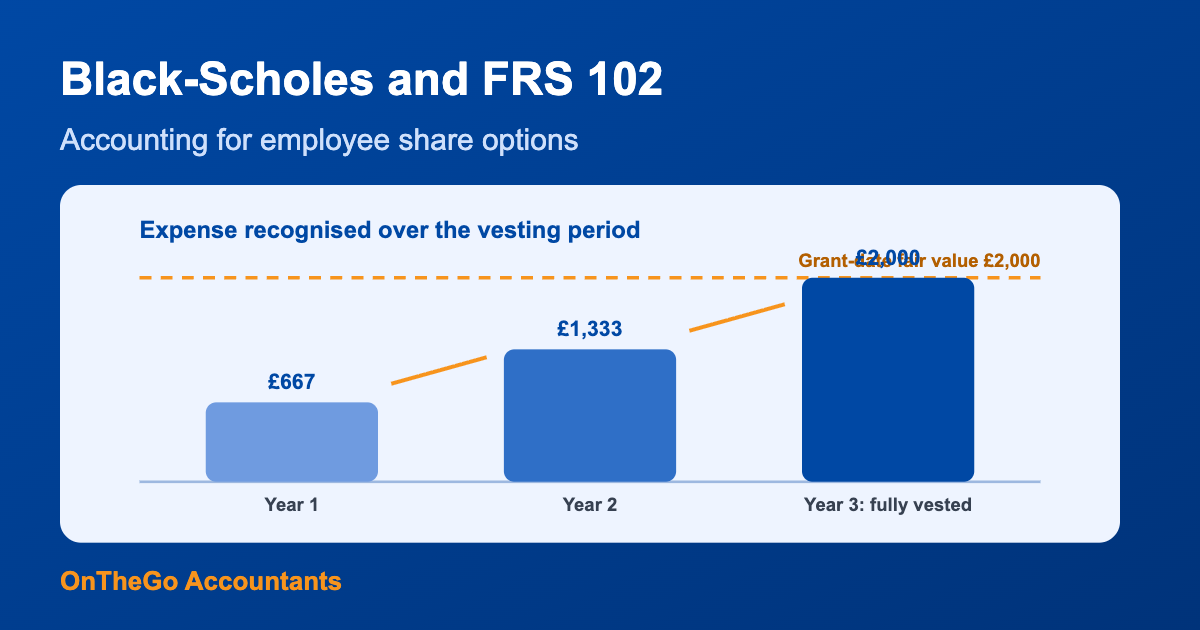
The valuation method can have a direct impact on the fair value assigned to employee share options. This, in turn, can affect the share-based payment expense recognised in the company's financial statements.
Under FRS 102 Section 26 and IFRS 2, businesses need to use an appropriate valuation approach and ensure the assumptions used are reasonable and supportable.
Using a model that does not adequately reflect the terms of the options could result in an inappropriate valuation and potentially lead to adjustments being required during the year-end or audit process.
It is therefore important to consider the valuation requirements when introducing a share scheme, rather than leaving the accounting implications until the financial statements are being prepared.
How Can OTG Help?
At OnTheGo Accountants, we provide specialist support with share-based payment valuations and complex financial reporting requirements. Whether your business requires a straightforward Black-Scholes calculation or a more sophisticated valuation approach, we can help assess the requirements and identify an appropriate methodology.
Our services include:
- Black-Scholes share option valuations.
- Monte Carlo and alternative valuation modelling support.
- EMI and CSOP-related accounting and valuation support.
- FRS 102 and IFRS 2 share-based payment accounting.
- Year-end reporting and share-based payment adjustments.
We understand that employee share schemes can involve complex accounting and valuation considerations. Our aim is to make the process clearer and ensure your business has the appropriate support in place.
Have a complex share option arrangement?
Get in touch with OTG to discuss your valuation requirements.
Speak to OTG