What Is the Black-Scholes Model? A Guide to Share Option Valuations for Businesses
Employee share schemes are an increasingly popular way for businesses to attract, reward and retain talented employees. Whether through Enterprise Management Incentives (EMI), Company Share Option Plans (CSOP) or other employee share arrangements, offering employees an opportunity to benefit from the future growth of a business can be a valuable part of a remuneration strategy.
However, introducing a share option scheme also brings accounting and valuation requirements that businesses need to consider.
One of the most widely recognised methods used to value share options is the Black-Scholes model. But what exactly is it, how does it work, and why might your business need one?
- Black-Scholes is a mathematical method for estimating the fair value of an option.
- Six key inputs drive the result: share price, exercise price, volatility, option life, risk-free rate and dividends.
- It is commonly used to support share-based payment accounting under FRS 102 Section 26 and IFRS 2.
- It is not suitable for every scheme, so the terms of the options matter.
What Is the Black-Scholes Model?
The Black-Scholes model is a mathematical valuation method used to estimate the fair value of financial options.
In the context of employee share schemes, it is commonly used to calculate the value of an option granted to an employee to purchase shares in a company at a predetermined price in the future.
An option has value because it gives the holder the opportunity to benefit if the underlying share price increases, without necessarily having to purchase the shares immediately.
Importantly, the value of an option is not simply the difference between the current share price and the exercise price. It also incorporates the potential for the share price to change over the expected life of the option. This additional element is known as time value.
The Black-Scholes model considers a number of factors to estimate this value, providing businesses with a structured approach to valuing employee share options.
What Factors Affect a Black-Scholes Valuation?
There are six key inputs that influence the valuation:
Current Share Price
The current fair value of the underlying company shares. For listed companies, this can generally be determined using the market price. For privately owned businesses, a separate share valuation may be required.
Exercise Price
The price at which the employee can purchase the shares when exercising their option. Generally, the lower the exercise price relative to the current share value, the more valuable the option.
Expected Volatility
Volatility measures how much the share price is expected to fluctuate over time. Higher expected volatility generally increases the value of an option because there is greater potential for the share price to rise above the exercise price. For private companies without an established share trading history, this can be particularly challenging. Comparable listed companies may be used to help establish an appropriate assumption.
Expected Option Life
This represents the period over which the option is expected to remain outstanding before exercise. A longer expected life will generally increase the value of an option, as there is more time for the underlying share price to increase.
Risk-Free Interest Rate
The model incorporates an appropriate risk-free interest rate, generally informed by government bond yields with a maturity consistent with the expected option life.
Expected Dividends
The expected dividend yield on the underlying shares can also affect the valuation. This depends on whether the option holder is entitled to receive dividends or equivalent benefits during the relevant period.
Each assumption can have a material impact on the final valuation, which is why selecting appropriate inputs is an important part of the process.
Why Do Businesses Need a Black-Scholes Valuation?
There are several circumstances in which a business may require a Black-Scholes valuation.
Employee Share Option Schemes
When a business grants share options to employees, it may need to recognise the fair value of those options as an expense in its financial statements. Under FRS 102 Section 26 and IFRS 2, an appropriate valuation methodology is required to establish the fair value of equity-settled options granted to employees. The Black-Scholes model is one potential method of determining this value.
Year-End Financial Reporting
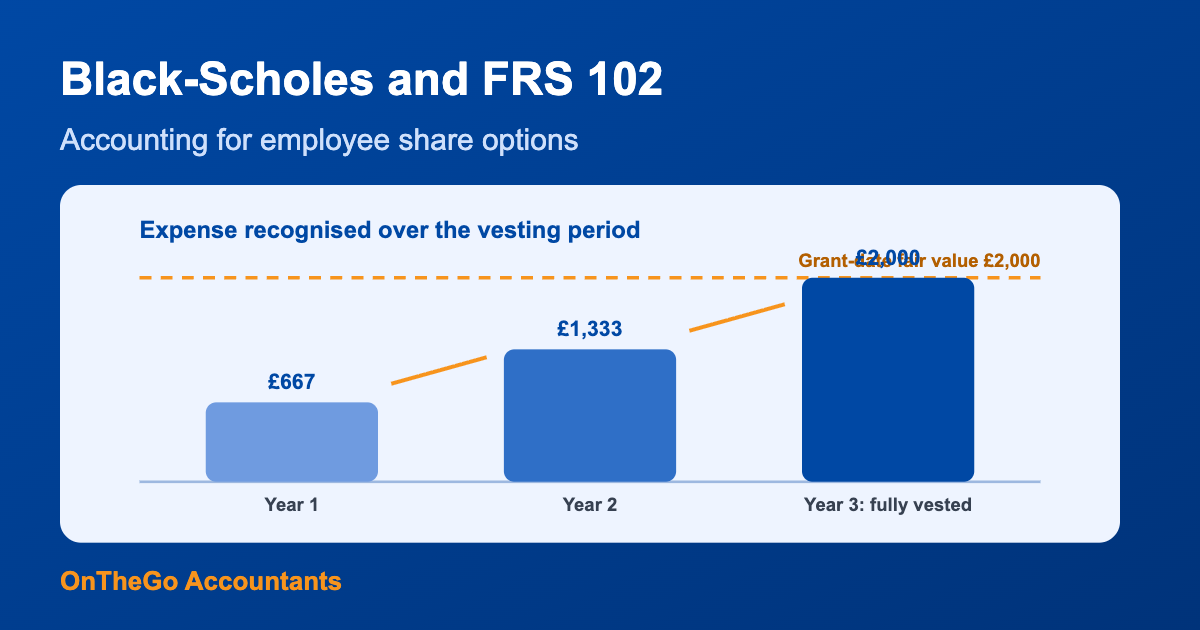
Businesses with employee share option arrangements may need to include a share-based payment expense within their year-end accounts. The valuation provides the starting point for calculating the accounting charge, which is generally recognised over the period in which employees satisfy the relevant service conditions.
Business Planning and Incentive Arrangements
A valuation can also help businesses understand the potential value of share incentives when designing or reviewing employee reward arrangements. It can provide useful information when considering the structure and financial implications of an employee share scheme.
Is Black-Scholes Suitable for Every Share Option Scheme?
Not necessarily.
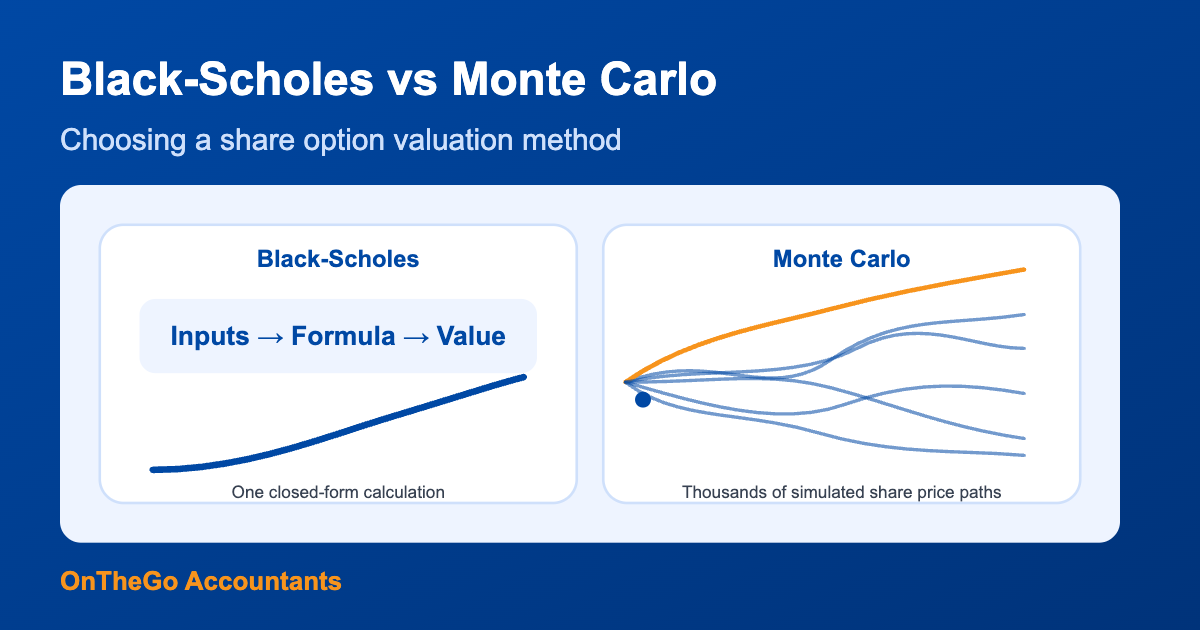
Although Black-Scholes is a widely used valuation method, it is not always the most appropriate model for every arrangement.
For example, some employee options have long contractual lives and allow exercise at various points after vesting. Others may contain more complicated performance conditions.
In these circumstances, alternative valuation approaches may be more appropriate:
The correct methodology will depend on the specific terms of the option arrangement and the assumptions required.
Why Is Professional Valuation Support Important?
A Black-Scholes calculation is only as reliable as the information and assumptions used within it.
Businesses need to ensure that the underlying share valuation, expected volatility, option life and other inputs are appropriately supported. This is particularly important for private companies, where there may be limited market information available to support the assumptions.
An inappropriate valuation could result in an incorrect share-based payment expense and potentially lead to adjustments being required to the financial statements.
How Can OTG Help?
At OnTheGo Accountants, we provide specialist accounting and valuation support for businesses with employee share schemes and more complex financial reporting requirements. Our services include:
- Black-Scholes share option valuations.
- Share-based payment accounting under FRS 102 and IFRS 2.
- EMI and CSOP-related valuation support.
- Financial reporting and year-end accounting adjustments.
- Support with more complex valuation requirements.
Whether you are introducing an employee share scheme or need to address an existing accounting requirement, our team can help you understand the valuation process and ensure the appropriate accounting treatment is considered.
Have a share option valuation requirement?
Get in touch with OTG to discuss how we can help.
Speak to OTG