Black-Scholes and FRS 102: How Should Employee Share Options Be Accounted For?
Employee share option schemes can be an effective way for businesses to reward employees, encourage long-term commitment and align employee interests with the future success of the company.
However, while much of the focus is often placed on designing and implementing the scheme, businesses also need to consider the financial reporting implications.
Under FRS 102 Section 26, share-based payment arrangements are subject to specific accounting requirements. This means businesses granting employee share options may need to recognise an expense in their financial statements, even where no cash payment is made.
A key part of this process is determining the fair value of the options granted, often using a valuation model such as Black-Scholes. So, how does this work in practice?
- Equity-settled employee options are measured at their fair value on the grant date.
- The expense is generally spread over the vesting period, with a debit to staff costs and a credit to an equity reserve.
- Service and non-market conditions change the number of options expected to vest; market conditions sit within the grant-date fair value.
- The accounting valuation is separate from any valuation needed for tax purposes, such as EMI.
- What is share-based payment accounting?
- Why is a Black-Scholes valuation required?
- How is the expense recognised in the accounts?
- How do vesting conditions affect the calculation?
- What happens if options do not vest?
- What information is needed at year-end?
- Does the accounting treatment change under IFRS?
- What about the tax treatment?
What Is Share-Based Payment Accounting?
Share-based payment accounting covers arrangements where a business receives goods or services in exchange for its own equity instruments or an amount linked to the value of those instruments.
For employees, this commonly includes:
Where a business grants employees share options in return for their services, it is effectively providing part of their remuneration in the form of an equity-based benefit. Under FRS 102, the value of this benefit needs to be reflected in the company's financial statements.
Why Is a Black-Scholes Valuation Required?
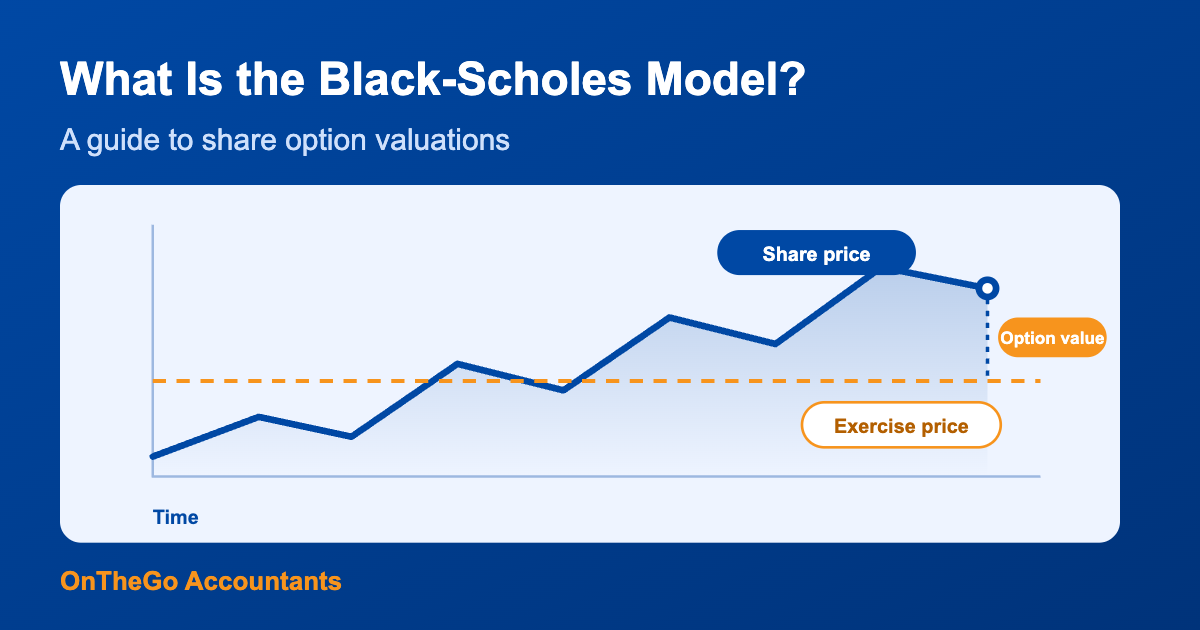
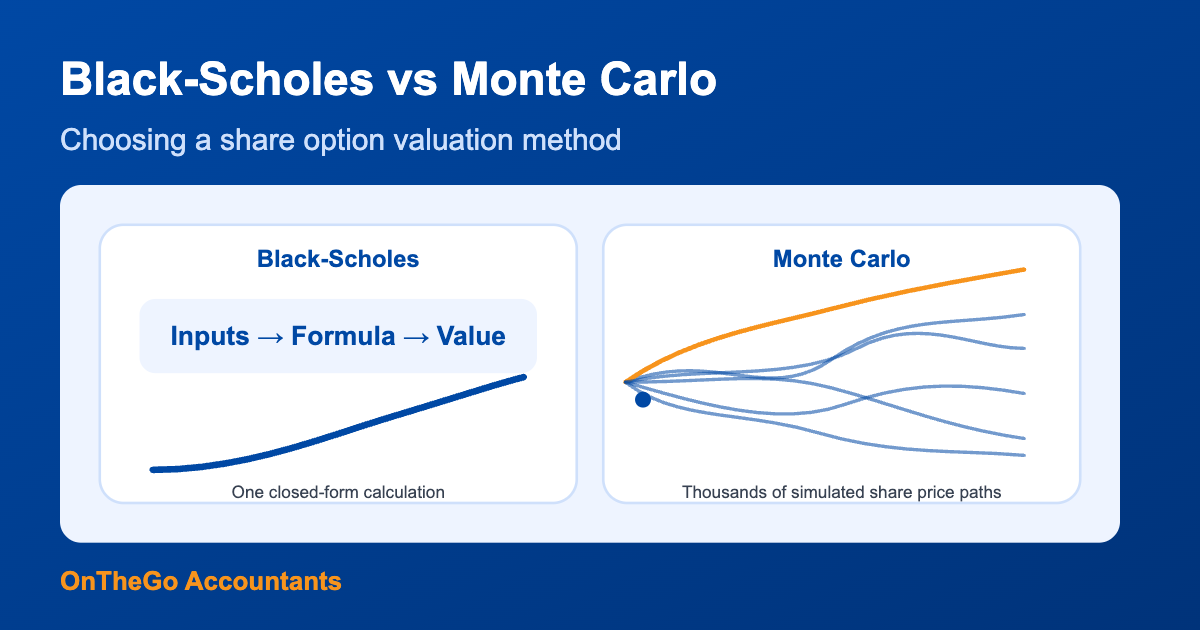
For equity-settled employee share options, FRS 102 requires the fair value of the options to be measured at the grant date. Where a directly observable market price for the options is not available, an appropriate valuation technique is used to estimate their fair value. The Black-Scholes model is one commonly used approach.
The valuation considers factors including:
- The current value of the underlying shares.
- The exercise price of the options.
- Expected share price volatility.
- Expected option life.
- The risk-free interest rate.
- Expected dividends, where relevant.
The resulting valuation establishes the grant-date fair value of the options, which is then used to calculate the accounting expense.
It is important to distinguish between the value of the underlying company shares and the value of the options themselves. A share valuation may be required as an input into the Black-Scholes calculation, but it is not the same as the final option valuation.
How Is the Expense Recognised in the Accounts?
For equity-settled arrangements, the accounting expense is generally recognised over the vesting period. The vesting period is the period during which employees must satisfy the relevant conditions before becoming entitled to their options.
Worked example
A company grants an employee 1,000 share options with a fair value of £2 per option. The options vest over three years, subject to the employee remaining with the company throughout that period.
Assuming the options are expected to vest in full and the service is received evenly over the three-year vesting period, the company would recognise an expense of approximately £667 per year.
The accounting entries would generally involve:
- A debit to staff costs within the profit and loss account.
- A corresponding credit to an equity reserve.
This reflects the value of the employee services received in exchange for the share options. The expense is recognised regardless of whether the employee ultimately chooses to exercise the options, provided the relevant vesting conditions are satisfied.
How Do Vesting Conditions Affect the Calculation?
One of the more important considerations in share-based payment accounting is understanding how the conditions attached to the options affect the expense. These generally fall into two categories.
Service and non-market performance conditions
For example, an employee may need to remain employed for three years or the company may need to achieve a specified profit target.
These conditions are not included in the grant-date fair value calculation. Instead, the business adjusts the number of options expected to vest when calculating the expense. The estimate should be reviewed at each reporting date and updated where necessary.
Market conditions
These may include requirements linked to the company's share price or total shareholder return.
Market conditions are reflected in the grant-date fair value of the options rather than being accounted for by adjusting the number of options expected to vest.
This distinction is important because it can materially affect the accounting treatment.
What Happens if Options Do Not Vest?
Where an employee fails to satisfy a service condition, such as leaving the business before completing the required vesting period, the options may lapse. In this situation, the business will generally adjust its estimate of the number of options expected to vest and revise the cumulative expense accordingly.
For equity-settled options, the accounting treatment is different where options have already vested but are subsequently not exercised. The expense already recognised is not simply reversed because the employee decides not to exercise their options. This is an important distinction when reviewing share-based payment balances at year-end.
What Information Is Needed at Year-End?
Businesses with existing employee share option arrangements should ensure they have sufficient information to support the accounting treatment. This may include:
- Copies of the share option agreements.
- The date the options were granted.
- The number of options issued.
- The exercise price.
- The vesting period and relevant conditions.
- The fair value of the options at grant date.
- The number of options expected to vest.
- Details of any modifications, cancellations or exercises.
The valuation assumptions should also be retained to support the calculation and provide an appropriate audit trail. Where a business has multiple share option grants, each arrangement may need to be considered separately.
Does the Accounting Treatment Change Under IFRS?
The broad principles are similar under FRS 102 Section 26 and IFRS 2, particularly in relation to measuring equity-settled employee options at grant-date fair value and recognising the associated expense over the vesting period.
However, businesses should ensure they are applying the correct reporting framework and the relevant version of the standard.
The revised FRS 102 requirements have a principal effective date of 1 January 2026 for accounting periods beginning on or after that date. The applicable version of the standard should therefore be checked when preparing financial statements.
What About the Tax Treatment?
It is important to recognise that the accounting valuation is not necessarily the same as the valuation required for tax purposes.
For example, where a business operates an EMI scheme, HMRC may be asked to agree the market value of the underlying shares at the date of grant. This is a separate exercise from calculating the fair value of the options for financial reporting purposes.
Businesses should therefore consider both the accounting and tax implications when introducing or reviewing an employee share scheme.
How Can OTG Help?
At OnTheGo Accountants, we support businesses with complex share-based payment accounting and financial reporting requirements. Our services include:
- Black-Scholes and other share option valuation models.
- FRS 102 Section 26 and IFRS 2 accounting.
- Calculating and reviewing share-based payment expenses.
- Year-end accounting adjustments and disclosures.
- Support with EMI, CSOP and other employee share arrangements.
Getting the valuation and accounting treatment right from the outset can help businesses avoid unexpected year-end adjustments and ensure their financial statements accurately reflect the arrangements in place.
Need support with share-based payment accounting?
Speak to OTG about your valuation and financial reporting requirements.
Speak to OTG